Wakatobi Island Guide: Indonesia’s Best Scuba Diving Destination
Discover Wakatobi National Park — 750+ coral species, 942 fish species, world-class luxury dive resorts. The reason 5,000+ divers fly 30+ hours every year.
Compare Dive Packages →Why Divers Fly 30+ Hours to Reach Wakatobi
You’ve probably read the Wakatobi National Park Wikipedia entry, scrolled through Instagram hashtags, and watched the BBC Earth segments. But the question that stops most divers from booking is simple: is it worth it? Wakatobi sits the Coral Triangle — the global epicenter of marine biodiversity. Allen and Erdmann’s 2003 survey documented 942 fish species and over 750 species of hard coral within the park’s 1.4 million hectares. By comparison, the Caribbean as a whole has roughly 65 species of hard coral. That’s not a typo. Wakatobi has more than 11x the coral diversity of an entire ocean basin.
The reefs here are also unusually intact. Because Wakatobi was declared a National Park in 1996 and a UNESCO Biosphere Reserve in 2012, large-scale destructive fishing (cyanide, dynamite) has been actively suppressed for nearly three decades. The Bajau “sea nomads” who have lived in the archipelago for centuries practice traditional sustainable fishing, and the four resort operators inside the park have a strong financial incentive to protect the reef walls their guests pay $1,200+ per night to dive.
What is Wakatobi? The Four Islands Explained
“Wakatobi” is a portmanteau of the four main islands: Wangi-Wangi, Kaledupa, Tomia, and Binongko. Together they form the Tukangbesi Archipelago in Southeast Sulawesi, Indonesia. Each island has a distinct personality:
- Wangi-Wangi — The administrative capital and arrival hub. Matahora Airport (WNI) receives daily flights from Makassar and Bali. Best for: first-time visitors, comfortable hotels, easy access to dive sites.
- Kaledupa — The cultural island. Home to the largest Bajau settlement (Sampela). Best for: snorkelers, cultural experiences, mangrove ecosystems.
- Tomia — The dive mecca. Hosts Wakatobi Dive Resort and the legendary Roma dive site. Best for: serious divers, photographers, premium experiences.
- Binongko — The remote frontier. Known for traditional blacksmithing and untouched walls. Best for: adventurous divers seeking solitude.
Marine Biodiversity: Why Scientists Call This “The Coral Triangle’s Crown Jewel”
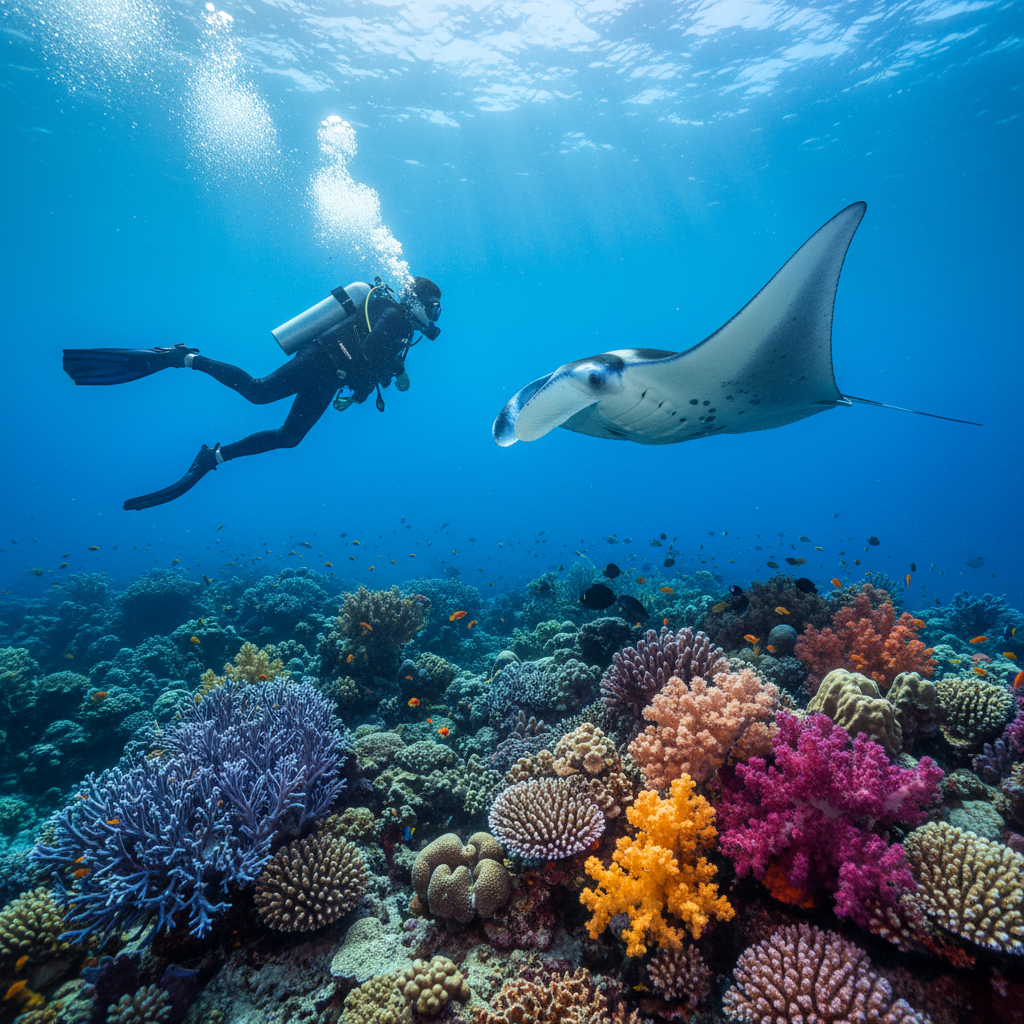
The numbers from the 2003 Allen survey remain the standard reference: 942 reef fish species (more than the entire Great Barrier Reef when measured per square kilometer), 750+ hard coral species, regular sightings of pygmy seahorses, mandarinfish, blue-ringed octopus, frogfish, and the elusive Rhinopias scorpionfish. Manta ray cleaning stations operate year-round at Karang Kaledupa. Pilot whales pass through the Banda Sea trench between June and October. Scalloped hammerheads schools have been documented at Cornucopia in larger numbers since 2018, likely due to ongoing protection of the seamount.
For underwater photographers, the Wakatobi house reef alone (the wall directly in front of Wakatobi Dive Resort on Tomia) hosts more than 25 distinct macro subjects identifiable on a single 60-minute dive. The wall drops from 3 meters to over 80 meters within meters of the shore. This combination of accessibility and density is — and we say this carefully — genuinely unique in the world.
The Best Dive Sites in Wakatobi (Ranked by Visitor Reviews)
- Roma — A submerged seamount rising from 200m to 8m. Pelagic action: trevally schools, occasional reef sharks, current-driven coral growth. Advanced only.
- Cornucopia — The wall that put Wakatobi on the map. Soft coral garden between 12-25m. Pygmy seahorse colony.
- Treasure Hill — Coral pinnacle teeming with reef fish. Suitable for all levels. Manta cleaning station nearby.
- House Reef (Tomia) — Walk-in macro paradise. Available to Wakatobi Resort guests 24/7. Night dives reveal mandarinfish mating.
- Magnifica — A staghorn coral garden with anemonefish carpets. Easy current.
- Trigger Wall — Vertical drop with massive sea fans. Photographer favorite for wide-angle.
Best Time to Visit Wakatobi
Wakatobi has two seasons: dry (April-November) and wet (December-March). Diving is excellent year-round, but the visibility and conditions vary:
- April-June — Peak visibility (30-40m), calm seas, optimal for photography. Manta sightings increase.
- July-October — Slightly cooler water (26-27°C), pelagic action peaks. Best for shark and ray encounters.
- November-December — Transition season, occasional rain. Quieter resorts, lower rates.
- January-March — Wet season. Surface conditions can be choppy, but water visibility often remains 20-25m. Macro diving is exceptional. Lowest rates of the year.
How to Get to Wakatobi
From international entry points, the standard route is: Singapore/Bali → Makassar (UPG) → Wangi-Wangi (WNI). Wings Air operates daily flights from Makassar to WNI in 1 hour 20 minutes. Wakatobi Dive Resort guests can also fly the resort’s chartered flight from Bali Denpasar (DPS) directly to Tomia airstrip — the only commercial-priced charter operating to a private resort airstrip in Indonesia. The full journey from a US/EU origin city is typically 24-36 hours including layovers, which is why most divers stay 7-10 nights.
Where to Stay: Resort Comparison
- Wakatobi Dive Resort (Tomia) — The flagship. $4,500-7,200 per person per week including all dives, meals, transfers. Awarded “World’s Best Dive Resort” multiple times.
- Patuno Resort (Wangi-Wangi) — Mid-range option. $150-250 per night. Good for budget-conscious divers using local dive operators.
- Hoga Island Dive Resort — Operations Wallacea research base, basic accommodation, $80-140 per night including dives. Spartan but authentic.
- Liveaboard alternatives — Pelagian Yacht (Wakatobi-affiliated), Damai liveaboards, and Dewi Nusantara cover Wakatobi on 7-12 night Indonesian cruise itineraries from $5,500-12,000.
What Does a Wakatobi Trip Actually Cost?
For a 7-night package at Wakatobi Dive Resort with 3 dives per day, expect to budget approximately:
- Resort package (7 nights): $5,500-7,200 (single occupancy: add 30%)
- Bali → Tomia charter flight: $730 round-trip per person
- International flights to Bali: $900-2,200 from US/EU
- Travel insurance + DAN dive insurance: $80-150
- Tips and incidentals: $200-400
- Total per person: $7,400-10,700 for a complete US/EU origin trip
Compared to Raja Ampat liveaboard diving ($6,500-12,000), Wakatobi offers comparable biodiversity at similar prices but with the added comfort of a stationary luxury resort and dedicated house reef. Many serious divers do both within the same trip.
Ready to Plan Your Wakatobi Diving Trip?
Compare 5-night vs 7-night packages, get current 2026 rates, and download the Wakatobi Diving Guide PDF.